College football is different.
No other sport has the built-in feature of regional conference tribalism that fuels discussion like college football. Additionally, television networks, through media rights deals with specific conferences, play a massive role in how fans interact with the sport and how the sport itself is shaped. Networks have a unique influence over key issues such as conference realignment and the college football postseason.
Fans have become acutely aware of which conferences are paid by which networks, and pundits on those networks, fairly or unfairly, can be cast as biased towards one conference or another.
These conflicts of interest are well known, and some biases are not subtle. But who are the worst offenders, and who has done a good job maintaining objectivity?
We asked, and thousands of our readers voted. Below are the results of Awful Announcing’s Inaugural College Football Media Bias survey, one of the most voted-on polls we’ve ever done.
Methodology
We asked for your votes in early December and put forth a list of 40 individuals. You can read more about how we developed that list. However, the basic criteria were that the individual had a national platform (we excluded those from team-specific sites or folks who worked primarily at conference-affiliated networks), college football was one of the leading sports that they covered, no play-by-play announcers or reporters (for the most part), and a focus on larger names that the typical fan might recognize.
The following question was asked for all 40 names.

Our methodology followed a formula that measured objectivity in two ways:
- The percentage of voters who selected “No notable bias observed.”
- Whether a person’s vote was equitably split between multiple conferences, or was there one conference that was much more selected than others, signaling a detectable bias.
And one last housekeeping note: any votes for “Unfamiliar with their work” were excluded and not included in our final tallies. We only considered the opinions of voters who were familiar with the person’s work.
So without further ado, let’s get to the rankings.
Awful Announcing’s 2025 College Football media bias rankings
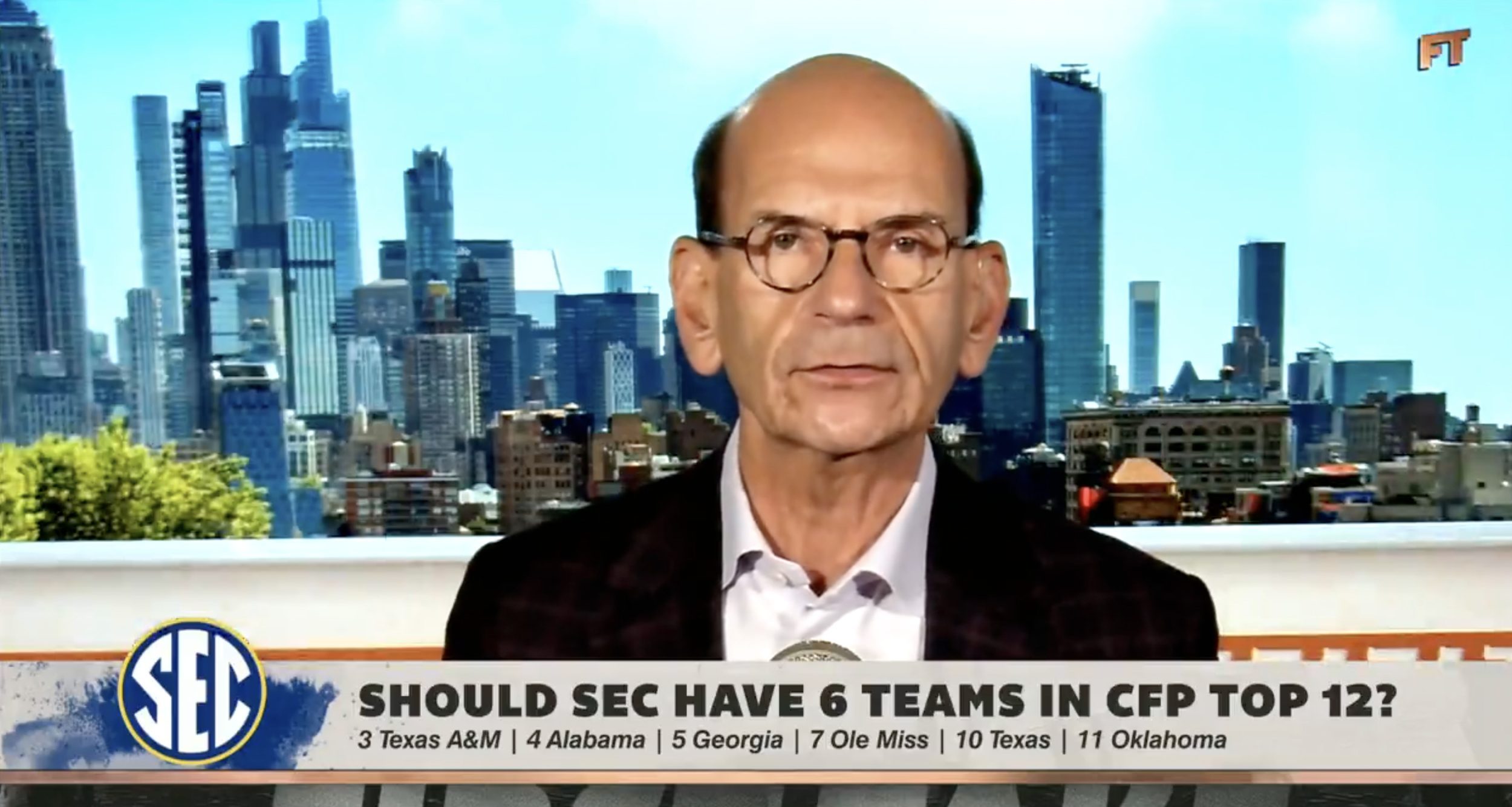
Paul Finebaum (ESPN) +97 SEC bias
We were not shocked that Finebaum topped our list. What was somewhat surprising was that his score was such an outlier, being 23 points higher than anyone else. Finebaum’s SEC-tilted coverage was no doubt going to register in our survey, but the fact that only about 1% of voters selected the “no notable bias observed” answer was a bit surprising, given that we believed many of our voters likely shared a similar level of bias toward the SEC. However, the voting did not go as planned.
It’s hard to say if ESPN and Finebaum will mind such a pronounced result. Is Finebaum’s noted bias a feature, and not a bug, and one that drives a lot of conversation that is deemed helpful to the network? We’ve seen other pundits thrive as a bit of a heel at ESPN, but that’s a tightrope to walk for extended periods. For now, Finebaum sits atop our bias rankings with no real competition.
Dave Portnoy (Barstool Sports and Fox Sports) +74 Big Ten bias
It would have been interesting to see how much Portnoy would have scored before landing on Fox’s Big Noon Kickoff, which has exposed him to a broader audience. The Michigan alum is certainly not shy with his opinions, nor ruffling feathers with any fanbase. While Portnoy made a lot of noise trying to lift the Big 12’s, BYU, into the playoff, ultimately Portnoy’s Michigan fandom and comfort level calling out other power programs (often outside of the Big Ten), led to Portnoy registering an impressive +74 bias towards the Big Ten, giving Fox their own pronounced biased analyst aligned with their business interests.
Nick Saban (ESPN) +71 SEC bias
Nick Saban’s addition to College GameDay has generally been well-received. However, Saban’s coaching ties and reverence for the SEC haven’t gone unnoticed. While a double-digit share of voters found Saban had no bias, the vast majority found him biased toward the conference in which he won seven national championships.
Leaned on for his unique coaching perspective, a bias score at this level feels like it might be higher than what ESPN would be comfortable with, given he’s the go-to individual for analysis in all facets of the sport. His bias score suggests a substantial number of fans take his interpretations with a hefty grain of salt.

Clay Travis (OutKick and Fox Sports) +67 SEC bias
It’s not much of a surprise that Travis landed here as the noted author of “Dixieland Delight: A Football Season on the Road in the Southeastern Conference.” Travis has been vocal and consistent in asserting the SEC’s supremacy across all his platforms. Coming in fourth most biased in our poll results, Travis is the highest individual on our list whose bias is not aligned with the business interests of the network that employs him (Fox has no business interest in the SEC).
Brandon Walker (Barstool Sports and appearances on FS1) +55 SEC bias
Rounding out our top five is Barstool Sports’ Brandon Walker. While Walker did register a bit lower in terms of recognition among our voters, with~40% of voters being unfamiliar with his work, Walker’s ties to the SEC (an avid Mississippi State fan) and consistently checking Dave Portnoy on his Big Ten homerism clearly registered with voters.
Greg McElroy (ESPN) +54 SEC bias
Perhaps if this were a few years ago, McElroy would have fared better. In 2023, McElroy was one of the few voices advocating for an undefeated Florida State to make the playoff over his alma mater, Alabama. McElroy has risen to become one of ESPN’s top analysts and also has the sensitive role of commenting on ESPN’s CFP rankings show, which draws extra scrutiny to any comments he makes.
With Alabama’s controversial inclusion in both 2023 and 2025, is McElroy paying the price for his bias toward the program he has the closest ties to, and that ESPN has a business interest in?
Booger McFarland (ESPN) +50 SEC bias
In a similar vein to McElroy, McFarland was one of the few voices who pushed for Florida State over Alabama in 2023. However, two years later, that dissenting opinion (especially at ESPN) has largely been forgotten, with a strong bias toward the conference in which McFarland played as a former LSU Tiger. McFarland is essentially a studio analyst for ESPN and also appears on the weekly CFP ratings show, which seems to be a job that largely offends fans.
Given discussions that the maligned weekly rankings could eventually go away, it would be interesting to see how McFarland, McElroy, and others’ scores would be affected, as they likely bear the brunt of aggrieved fans’ frustration.
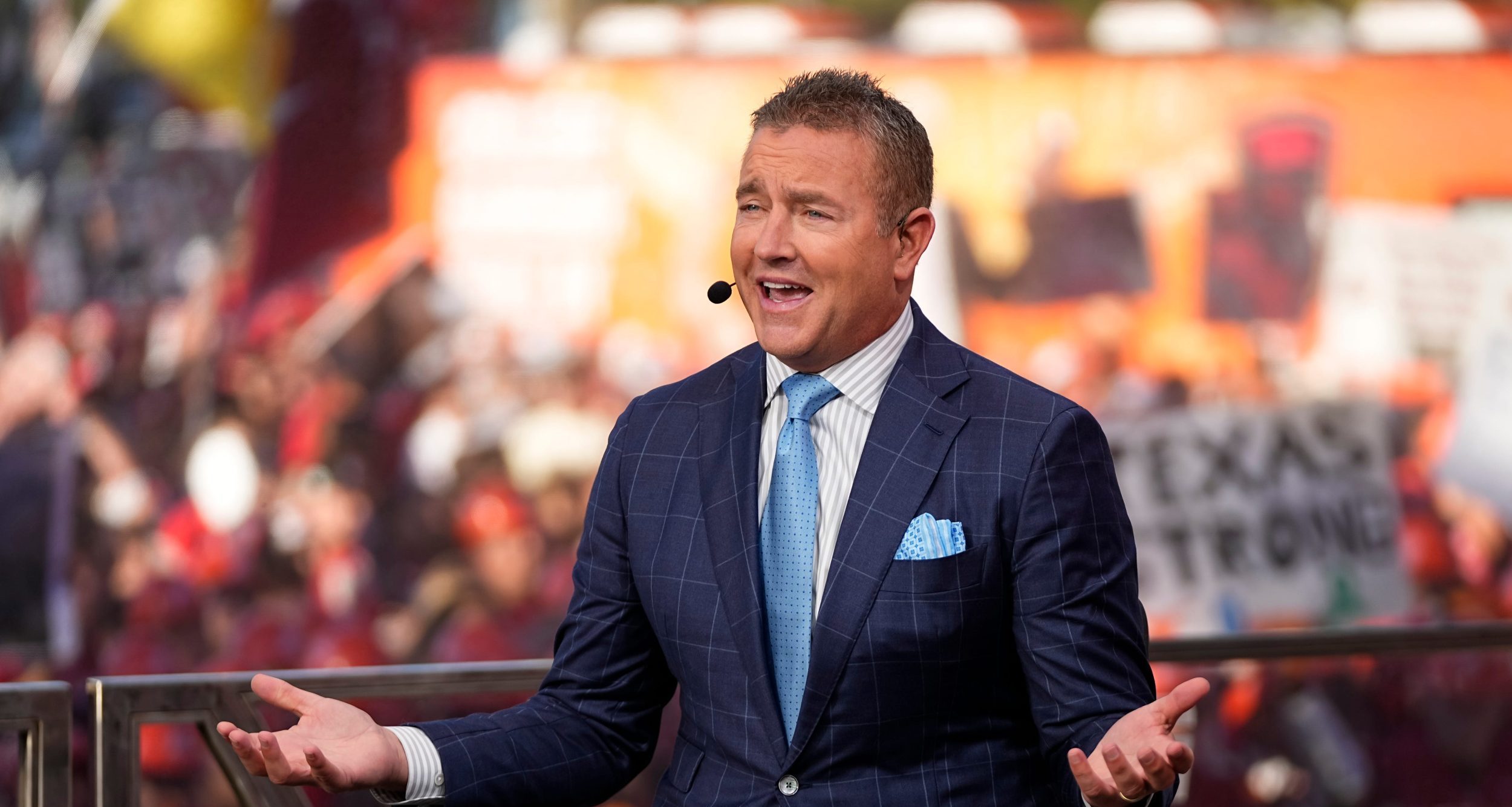
Kirk Herbstreit (ESPN) +44 SEC bias
ESPN’s leading personality covering college football can’t seem to escape the accusations of bias despite multiple efforts to push back against the narrative. Herbstreit has gone as far as saying, “These people talking about the SEC, how much they pay you — are you kidding me? I’ve been here for 30 years.”
Herbstreit is the highest-ranking individual in our poll who reported a bias that didn’t tie to an alma mater or a recent coaching job. Herbstreit, a former Ohio State captain, clearly disagrees with the insinuation that he’s in the bag for ESPN and the SEC. Unfortunately for Herbstreit and ESPN, there is still work to be done, as nearly two-thirds of our voters believe there is a bias toward the SEC despite Herbstreit’s continued protests.
Brady Quinn (Fox Sports) +37 Notre Dame/other bias
We’ll attribute much of this to bad timing: Notre Dame’s surprise exclusion and Quinn’s participation in the Notre Dame grievance movement likely triggered a surge in the polls. Quinn’s coverage of Notre Dame is modest mainly in his role on Big Noon Kickoff, but as our voting started, Quinn was quite vocal about the Irish’s exclusion.
What will this look like a year from now? If Notre Dame makes the playoff or misses the playoff by a healthy margin, we’re confident Quinn’s bias for his alma mater would likely recede by a notable margin.
Taylor Lewan (Bussin’ with the Boys and appearances on ESPN) +37 Big Ten bias
Ultimately, if this exercise reveals anything conclusive, it is that it’s hard to overcome biases, real or perceived, tied to where you last played or coached. Lewan, a former Michigan player, tripped the wire for bias toward the conference that helped make him. While that trend is consistent, Lewan’s score clearly outperforms many other former players on this list.
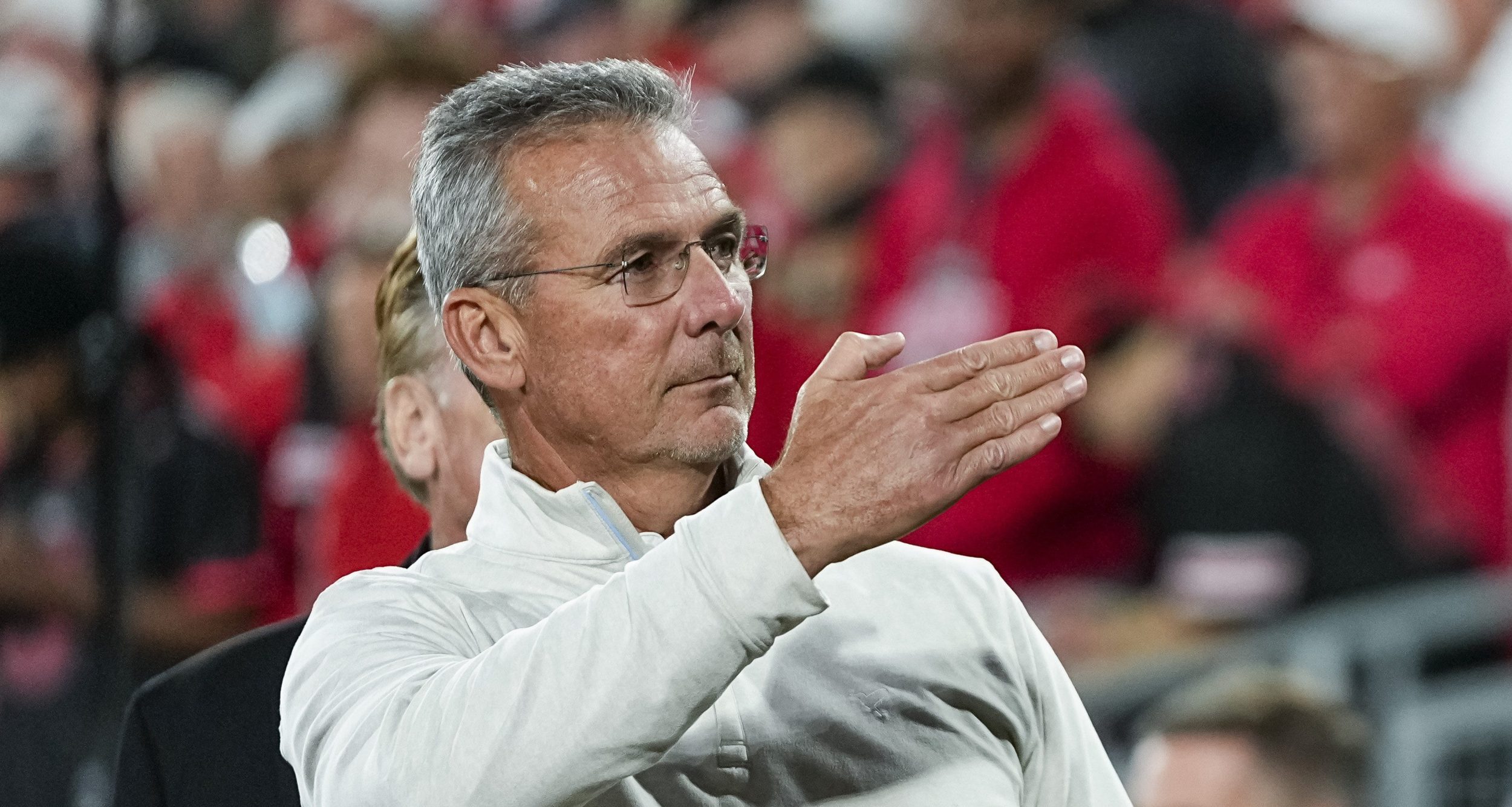
Urban Meyer (Fox Sports) +36 Big Ten bias
One of the things we were most curious about in putting this together was how the network comparisons would stack up, with Fox’s Joel Klatt versus ESPN’s Kirk Herbstreit and Fox’s Urban Meyer versus ESPN’s Nick Saban at the top of that list. In both cases, the ESPN individual scored notably higher than their Fox peer.
Is Meyer more objective than Saban? Perhaps his extended time at Florida and Utah helps balance out his perspective? Or maybe the ESPN and SEC bias narrative has grown deeper roots over time? Either way, Meyer showed a clear bias toward his last college football head-coaching stop, but his score was almost exactly half of Saban’s bias toward the SEC.
Danny Kanell (CBS and SiriusXM) +33 ACC bias
If you’re looking for ACC bias, Danny Kanell is your guy and the only ACC homer on our list. Kanell has long been vocal on social media and other platforms advocating for the ACC, where he starred decades ago at Florida State. Additionally, Kanell has been vocal in calling out biases favoring the SEC and the Big Ten, so it’s not surprising to see him land on our list. Given how Big Ten- and SEC-centric our list is, it’s nice to see bias registering for a different conference. Kanell is also the individual highest on our list without a tie to Fox or ESPN.
Mike Golic Jr. (TNT Sports) +33 Notre Dame bias
Similar to Brady Quinn, timing is likely unkind to Golic Jr., as the aftermath of Notre Dame’s exclusion from the CFP coincided with our voting window. We thought Golic’s role covering the Big 12 for TNT might sway voters in that direction, but only about 1% of votes indicated that. Similar to Quinn, we expect a year without Notre Dame on the CFP bubble will yield a different number next year.

Joel Klatt (Fox Sports) +31 Big Ten bias
This is probably a score Fox can live with. Klatt has been one of the loudest and most consistent counterbalances to the dominant SEC narrative. This contrarian POV routinely has Klatt advocating for the Big Ten, a perspective that has worked out well over the last two years, with no SEC school making the CFP title game since 2023.
A little less than half of our voters flagged Klatt for a Big Ten bias. However, given his role at Fox, that’s likely the level of bias both he and the network are aiming for, as the Big Ten seeks a differentiated approach to coverage from ESPN’s SEC-centric coverage.
Desmond Howard (ESPN) +31 Big Ten bias
Is bias sometimes a good thing? ESPN continues to face accusations of favoring the SEC, a claim borne out by our results.
But Howard, with a noticeable bias towards the conference he played in as a former Heisman winner from Michigan, goes against that narrative (similar to Clay Travis at Fox). While perhaps a negative for Howard, is having a flagged bias for the SEC’s biggest rival a good counterbalance to point to? If you’re Howard’s agent, that’s probably a case worth making.
Will Compton (Bussin’ With the Boys and appearances on ESPN) +29 Big Ten Bias
As a proud Nebraska alum and one of the program’s most prominent personalities, it’s hardly a surprise that Compton would have some Big Ten bias attached to his name. All things considered, the ex-NFL linebacker’s +29 bias score is hardly egregious, and notably ranks eight points lower than his BWTB co-host, Taylor Lewan
Josh Pate (Josh Pate’s College Football Show) +27 SEC bias
Perhaps no member of the college football media has seen his star rise in the last few years like Josh Pate. In addition to hosting Josh Pate’s College Football Show, which has partnerships with On3 and Yahoo, he has also begun making regular appearances on ESPN.
As someone with strong convictions who’s never shy about voicing his opinion, Pate is a natural target for claims of bias. And that manifested itself in the form of a +27 score from readers who feel that he’s outwardly favorable toward the SEC.
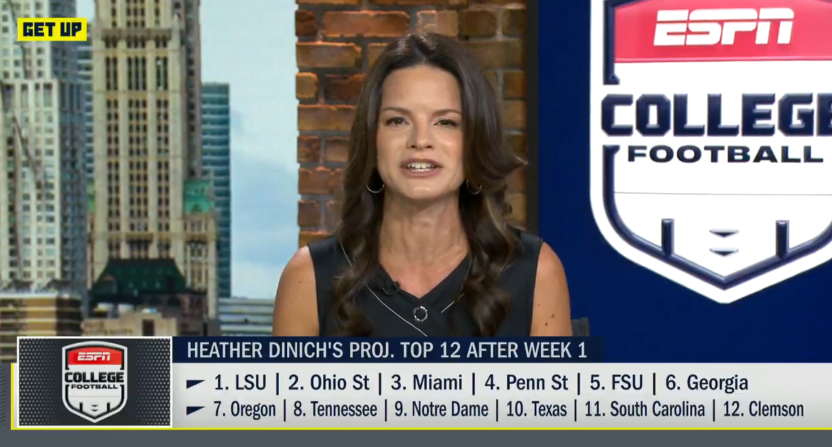
Heather Dinich (ESPN) +26 SEC bias
Dinich has one of the most difficult-to-navigate roles at ESPN as the resident CFP selection committee reporter. Dinich also provides commentary of her own. Between the two roles, Dinich has logged a notable +26 SEC bias, which is high for her role and is something you’d hope to clean up to be as unbiased as possible in public perception.
Is this score earned because of her reporting or commentary, or is this more tied to fans being annoyed at the pro-SEC outcomes she is often delivering/reporting on the network that has a business relationship with the SEC? Either way, the days of Brad Edwards and the BCS Computer are a distant memory.
Jesse Palmer (ESPN) +26 SEC bias
As a longtime ESPN analyst and former Florida quarterback, Jesse Palmer seems like an obvious target for accusations of SEC bias. Although he registered a +26 score for the conference he attended during college, it’s worth noting that he is on the lower end of the personality distribution for those who qualified for our “bias detected” category.
Dan ‘Big Cat’ Katz (Barstool Sports and appearances on Fox and FS1) +20 Big Ten bias
Nobody would ever mistake Big Cat for Big J Journalist. And as a proud Wisconsin alum, the Pardon My Take star has never been shy to wear his support for the Badgers on his sleeve.
In many ways, Katz’s Big Ten bias is a feature, not a bug, as a big part of Barstool’s appeal is that its personalities lean into their fandoms. If anything, it speaks volumes that he didn’t score higher, considering that, unlike others on this list, he isn’t even trying to feign objectivity.
Matt Barrie (ESPN) +19 SEC bias
An emerging voice for ESPN covering college football, Barrie shows up towards the bottom of the pack of ESPN voices with a modest SEC bias of +19. Is that number more to his ESPN affiliation, or perhaps the fact that Paul Finebaum is a regular on his podcast, or more indicative of his actual commentary?
A very proud Arizona State alum, Barrie is among a few on this list who may have registered as having a Pac-12 bias but has fallen away as the conference splintered and any bias is now harder to pin to a new, larger conference.

Mark Ingram (Fox Sports) +18 SEC bias
This is probably a good indicator of how hard it is to overcome perceived bias toward your alma mater. Ingram, a Heisman winner from Alabama, clocks in at +18 SEC bias at a network with no affiliation with the SEC. And yet, Ingram spoke against Alabama making the playoff. Ingram also scolded Dave Portnoy for his infatuation with Diego Pavia. Ingram seemed to do well by dissociating himself from the bias of his former conference, but perhaps the built-in perception of bias toward one’s alma mater led us here.
Matt Leinart (Fox Sports) +16 Big Ten bias
Similar to Matt Barrie, this is one where perhaps Leinart would have been different if we did this before the demise of the Pac-12. Leinart registered with some bias toward his alma mater’s new conference home, which aligns with his employer’s business interests. We’re interested in how his perceived bias has shifted over the years as we move further from the most recent round of realignment.
Gary Danielson (CBS Sports) +12 SEC bias
Is it actually a bad thing for CBS that Danielson, who now calls Big Ten games, didn’t register bias towards that conference? I think leagues and conferences would like some home cooking to warm up fans within reason. Did Danielson actually talk up the SEC too much while calling Big Ten games? That seems unlikely as he’s a long-time veteran. Most likely, this is residual memory from his two decades of calling SEC games for CBS. With Danielson retiring, he goes out known as a pro-SEC voice, and that’s probably something he’s good at, given all the years he called signature games for the conference, even if he is a former Purdue player.
Andy Staples (On3) +12 SEC bias
Having been a national college football voice for nearly two decades, Andy Staples isn’t somebody often associated with outward bias — especially when compared to some of the other pro-SEC names on this list. But his past as a Florida walk-on and his affinity for his alma mater apparently were enough to earn him a +12 score, indicating at least some bias among viewers.
Robert Griffin III (Fox Sports) +11 Big 12 bias
Is it weird that we’re happy to see the Big 12 and ACC on the list, even if it’s just once for each? RG3 calls Big 12 games, and the former Heisman winner hails from Baylor, hence this was probably predictable. However, in the scheme of things, his bias ranking was much lower than that of most former players. Given that there are few voices advocating for the Big 12, it’s plausible that both Fox and RG3 would oddly see an opportunity to lean into this further?
At the end of the day, fans want neutrality (or at least say they do), and RG3 certainly seems to be doing a good job of achieving that. But fans also want representation, and there may be an opportunity for voices favoring the ACC and Big 12 to make more noise—something to watch for RG3 and Kanell going forward.
Todd McShay (The Ringer) +10 SEC bias
While he’s primarily associated with his NFL Draft coverage, a lot of McShay’s analysis is rooted in college football’s week-to-week operations. Given that the conference consistently produces the most NFL players, a pro-SEC approach might be natural.
Minimal Bias Detected
The following individuals registered only a single-digit bias score for any specific conference. Consider this the list of people in college football media who fans perceive as the most objective.
- Pat McAfee, ESPN
- Ari Wasserman, On3
- Rick Neuheisal, CBS
- Adam Breneman, CBS,
- Tim Brando, Fox
- Joshua Perry, NBC
- Nicole Auerbach, NBC
- Scott Van Pelt, ESPN
- Colin Cowherd, Fox
- Petros Papadakis, Fox
- Todd Blackledge, NBC
- Adam Lefkoe, TNT
- Joey Galloway, ESPN