Will Buxton has been the voice of IndyCar since Fox Sports gained the rights to the series in 2025.
The veteran motorsports announcer covered Formula One for many years, first with Speed Channel and NBC in the States before joining the series itself as one of their lead presenters. He is also known worldwide for his work on the Netflix series Drive to Survive, where he serves as the connective tissue and often explains the narrative to non-race fans.
But Buxton stepped back into a play-by-play role with the move to Fox and IndyCar, and had one of the seminal moments of his career at the 2026 Indianapolis 500. Buxton’s brilliant call of the dramatic last-lap pass by Felix Rosenqvist on David Malukas met the moment and then some. It was the closest finish in the illustrious history of the Greatest Spectacle in Racing. And as the behind-the-scenes video of his call from the broadcast went viral, it showcased his passion and love for the sport.
Will Buxton spoke with Awful Announcing ahead of IndyCar’s race this weekend on the streets of Detroit to talk about his move to IndyCar, the dramatic Indy 500, and the old-school microphone that put his career back on track.
This interview has been edited for length and clarity.
Awful Announcing: What went into your decision to leave F1 and come to America to be the voice of IndyCar for Fox Sports?
Will Buxton: I’ve been with Formula One for 25 years, and I had loved every moment of it. But I’m a race fan first and foremost, and I’ve always been a fan of IndyCar. I’d spent some time over in the States back in 2012, the final year that I was with Speed Channel before the rights moved to NBC. And I was actually looking for a way to move to IndyCar back then because I loved it and I’d always been searching for the potential of a role.
I loved IndyCar, and there was something about the paddock that I just adored. I’ve always loved the racing here, I’ve loved the sense of community, and I really wanted to be a part of it. It didn’t happen, and I continued with F1 and loved working with F1, absolutely loved my time there. And I thought my time to have transitioned to IndyCar had gone. Then we’re getting to the end of the 2024 season, and I’m talking to Formula One, and we were talking about getting the new contract done with F1, and suddenly out of nowhere I had a conversation with James Hinchcliffe, and he said Fox were interested in having a conversation. I didn’t know quite what they were looking at, and they called me and said we’d love you to do play-by-play. And it just took me completely by surprise. And I didn’t really need to think about it. I pretty much immediately said yes because I never thought the opportunity would come up, and when it did, it was a really easy decision to make.
I can say with all honesty it’s the best decision I’ve ever made. I’m having more fun than I think I’ve ever had. I feel ten years younger; I feel this great surge of enthusiasm and love again for racing. It’s been a heap of fun.
Was there anyone at F1 or in your life at the time who tried to talk you out of it given the view of IndyCar within F1?
I’m sure there were people who thought it. I didn’t. Not for a moment. Because I know what IndyCar is and I know what it has the potential to be. We know within racing that IndyCar has the best racing on earth. It’s the best kept secret in motorsport that IndyCar is actually the coolest thing. It’s no shock that when Max Verstappen had just finished the Canadian Grand Prix the first thing he wanted to do when he got into the press conference room was he asked somebody to get a phone out because he wanted to watch the end of the Indy 500. Everyone loves IndyCar; it doesn’t matter what you’re racing. Everyone knows IndyCar has the best racing on earth.
On that final lap, was there a moment you thought this pass could happen, we could see something historic? Because Felix Rosenqvist was side-by-side with Marcus Armstrong for so long that it looked like David Malukas had the race won.
Honestly, from the run down to two and three, this is Malukas’ all day long. As soon as Felix stayed high and I saw the run he was getting through three, that’s the point I shouted, “it’s not over” because this guy has got the tow, he’s got the overrun on speed. But then he’s on the outside of four; there’s no way he makes it round the outside of four. And I think in that moment I was just thinking it’s not over, and he’s either going to go into the wall, or he’s going to keep this thing pinned. And if he keeps it pinned, he’s got a chance.
And then Townsend [Bell] starts punching the air. And if Townsend’s getting that excited, then I’m like, oh shit, maybe he does have a chance. And then it turns out he did. And then what transpired transpired, and it was one of the great endings of any Indy 500 in history.
That call has been so well received and so appreciated by fans in meeting the moment. What does it mean to you to not just be the voice of IndyCar now but to have a piece of Indy 500 history in a call that will be replayed for years to come?
I don’t think that’s sunk in, if I’m totally honest with you. When you say that, that’s goosebumpy for me because I love this race, I love this championship. I don’t really know what to do with that, to be honest with you.
At the end of that clip inside the booth, there’s a moment after Rosenqvist crosses the finish line when you are totally in the moment, and James Hinchcliffe and Townsend Bell put their hands out to say to let the moment breathe, because I imagine it would have been totally natural to just keep going and get completely lost in the excitement.
We work incredibly well as a booth. We are great friends away from the track; we’re great friends at the track. You need to have that intrinsic understanding of one another and to know from body language, from a simple hand movement, what everybody is thinking. We try as much as we can on a slow down lap to lay out as much as humanly possible. And in that moment of the high intensity of it, James putting his hands out the way he did and all of us taking a step back, we all knew in our heads, but it was that moment to let it sit. It’s funny because I use an old school mic, and when I lift that to my mouth, the guys know I’m coming in to talk, so there’s that visual reference there.
A lot of it is we naturally feel it. We know when each other would naturally want to drop in because of the cadence of our conversation that we have at dinner or wherever. We know each other now so well that it becomes an easy thing for us to know what each other’s thinking and what each other wants to do. In those moments, it’s great we’re all on the same wavelength.
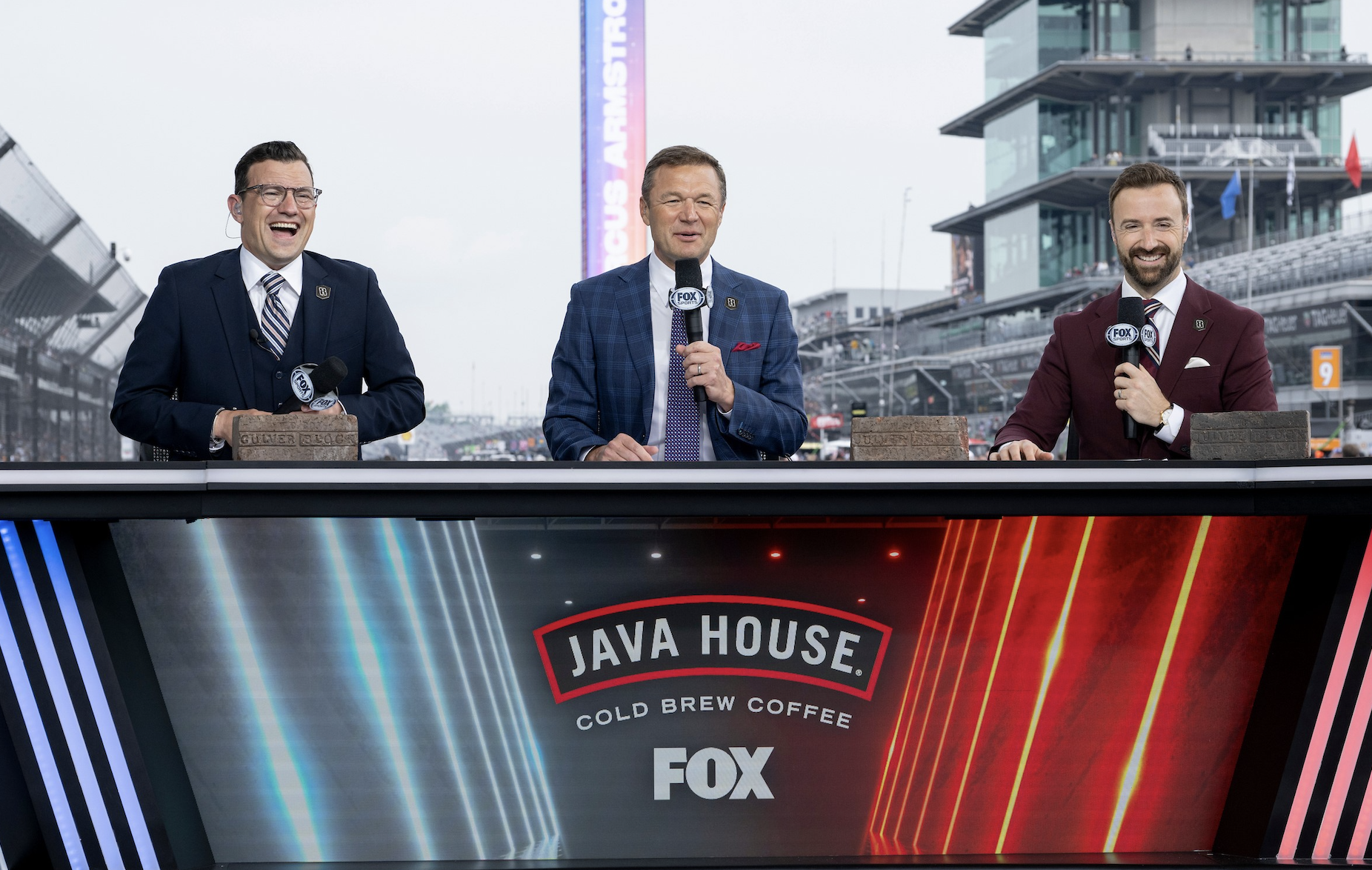
What is the story behind the old school microphone? Because it looks like you might be reporting on the Hindenburg Disaster, but it’s really cool to see in 2026.
It’s called a lip ribbon mic, and it’s made by a company called Coles. I believe they were developed during the First or Second World War as a war reporter’s microphone because it’s incredibly directional. There’s a bar on the top of the microphone that sits on your top lip so your mouth is always equidistant from the microphone itself so you never get any differentiation of a distance away from the mic. Because it’s also very directional, it cuts out a vast majority of the ambient noise.
For the best part of the last century, British commentators in particular have used them in stadiums for soccer, rugby, cricket or whatever. Fans of motorsport will know it’s something Murray Walker used for years to do his Formula One commentary. The reason is because the commentator’s booth doesn’t exist at British stadiums, the commentators are literally sat with the fans and surrounded by 80,000 screaming, chanting soccer fans. It’s pretty difficult to make yourself heard, and these microphones were perfect for that.
When I started doing commentary a long time ago, it was just the go-to microphone that everybody within motorsport used because it was a traditional British thing. When I came back to doing commentary last year with Fox, it was on headsets, and I got to be honest, for the first half of last year, even through the 500, I didn’t feel at ease with doing the job. All of these things were going through my head: why has it not meshed to where I know I can be and where I feel I should be within my role?
I said to Fox, “Can I get a Coles mic please?” They were like, “Why do you want to use one of them?” I was like, “Just humor me, please.” Suddenly everything just started to feel a bit easier for me because it was what I was used to. And at the same time there’s this visual cue, and I just felt comfortable and felt at one doing my job. From that, it started to feel easier, so I stuck with it, and I will probably stay with it now for as long as I possibly can.
After the thrilling Indy 500, where does IndyCar go from here given ratings are up this season, and you have this unique investment from Fox where every race is on network television in an age where more sports are going behind streaming paywalls? How do you build on this?
I love the fact that Fox has bucked the trend and putting IndyCar in a place where everybody can see it. Everybody can access it. Everybody can enjoy it. It showed last year in the figures. Last year we were just trying to get a baseline. And I don’t think this is publicized enough. Last year Fox’s average viewership for IndyCar was 1.2 million viewers a race. Formula One’s viewership last year in America was 1.2 million fans a race. Year one with Fox of making everything available to everyone on network equaled Formula One for viewership in America. Formula One is supposed to be on this massive boom, more popular than ever in America. It’s the big thing, what everyone is talking about. We equaled them. That’s not talked about enough because that tells me IndyCar is having a massive moment.
Our viewership this year is up on last year. IndyCar is in a brilliant place, and Fox has done a wonderful thing by making it available to everyone. So where the future lies is absolutely huge. If you look at IndyCar and the investment they are making, the huge investment Fox is making in the sport, if finding our baseline was at 1.2, three times what Formula One had when Liberty Media took over, and you see the growth Formula One had by Liberty’s investment, imagine where we might be in four to five years time with the push Fox is making alongside IndyCar to grow this sport suddenly starts to show that growth. We’re in a much better place than anyone imagined or expected us to be. That’s why the future for IndyCar is so positive and so good.
About Matt Yoder