The NFL’s status as the most-watched programming in all of television is hardly a secret. Year after year, the public is inundated with headlines about how the NFL just put on the “most-watched Super Bowl in history,” or at least another superlative to that effect.
But the sheer scale of the NFL’s grip on our collective attention is a bit harder to put in perspective. That’s where little nuggets of data from firms like Nielsen can help our understanding. On Tuesday, the audience measurement company released its monthly The Gauge report, which details the television viewing habits of Americans.
As part of its report, Nielsen breaks down what percentage of total television consumption takes place on streaming, broadcast, and cable. Recently, streaming overtook broadcast and cable television combined to secure the plurality of time spent watching television in the United States.
That’s no surprise given the ubiquity of streaming in 2025. What might be surprising, however, is just how much impact the NFL has on another one of those categories: broadcast.
Every Sunday afternoon during the fall, millions of Americans, like clockwork, flip on their local CBS and Fox affiliates to watch the NFL. It’s not an exaggeration to say NFL programming is quite literally keeping legacy media companies like these in business. What does that look like from an audience share perspective?
Well, Nielsen tallied up the share of television viewership between streaming, broadcast, and cable from Monday through Saturday during October and compared those splits with viewership on Sundays, and the data clearly shows just how much impact the NFL has.
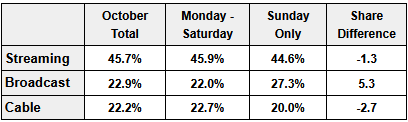
As the table above shows, the share of television audiences watching broadcast networks jumps from 22.0% between Monday and Saturday all the way to 27.3% on Sunday. That’s an approximately 24% increase in broadcast’s share of television viewing when it airs NFL games.
Not only are the broadcast networks benefiting, but NFL telecasts are clearly eating into the audiences that would otherwise be watching streaming or cable. The share of streaming viewers goes from 45.9% to 44.6%, about a 3% drop off from its Monday to Saturday baseline, while cable declines from 22.7% to 20.0%, about a 12% decline from its non-Sunday baseline.
The data shows just how powerful the NFL is when it comes to television consumption in the United States. Not that we needed any reminders.
About Drew Lerner
Drew Lerner is a staff writer for Awful Announcing and an aspiring cable subscriber. He previously covered sports media for Sports Media Watch. Future beat writer for the Oasis reunion tour.